
34 posts Posts by becca

steamed egg

I’m typically not a very big eater.  When I was young, sometimes I’d make it through my whole 2/3-full bowl of rice with one small chicken wing.  But on the days my dad made steamed egg, I would happily get second and third helpings of rice just so I could eat more of the steamed egg!  This dish always reminds me of home — the smooth, silky soft texture is so comforting and easy to eat lots of.

I remember we used to make this dish with simply eggs and water, but over the years, both my parents and I have experimented with substituting the water with different liquids and also adding in other ingredients to enhance the flavor. My parents also learned a trick from my Aunt Grace, which is to mix the eggs with hot and then cold liquid prior to steaming. This helps lessen the cooking time when the egg steams, creating a smoother texture and preventing overcooking. For the creamiest and most flavorful version, I’ve started using hot chicken broth and cold milk.

This dish can be eaten plain (as I did for my meals in college) or served as a side dish with rice and other meat or vegetable dishes.  I like it best mixed in with rice!

Steamed Egg

The proportion of egg to hot liquid to cold liquid is roughly 1:1:1.  You can adapt this recipe accordingly to make more or less. This ratio gives the steamed egg a consistency like soft tofu.
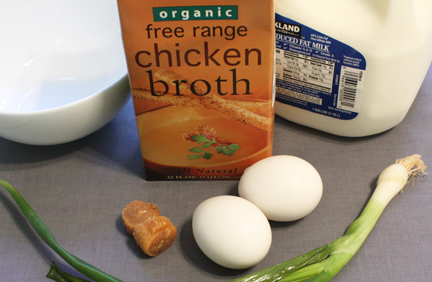

2 eggs
3/4 c. hot chicken broth (or less if adding dried scallop water)
3/4 c. cold milk
2 dried scallops (optional)
pinch of salt

topping:
dash of Maggi (or soy sauce)
sesame oil
scallions, chopped

1. Soak dried scallops in warm water for 30 minutes or until soft enough to tear apart. Save liquid.  (Hot water will soften the scallops even faster.) When soft, tear the scallops into very thin shreds.

2. In a heatproof bowl, beat the eggs together with 3/4 of the scallop pieces.

3. Combine dried scallop water with chicken broth to make 3/4 cup liquid. Heat the scallop water and broth to just before boiling.

4. Slowly add the hot liquid to the egg and scallop mixture, whisking continuously. After all the hot liquid is incorporated, whisk in the cold milk, and then add the salt.

5. Cover the heatproof bowl with a piece of clear saran wrap. This step is important to ensure that the top of your steamed egg is silky smooth.  If left uncovered, the condensation inside the steamer will drip and create dimples on the surface of the egg.

6. Place the bowl in a steamer and steam on medium-high for about 12 minutes (time will vary depending on steamer/bowl/stove)

7. After about 12 minutes, sprinkle the remaining 1/4 of the dried scallop pieces on top of the eggs.  Replace the saran wrap with a fresh piece (the already removed saran wrap will have lost its cling). Steam for another 3-5 minutes.  When the steamed eggs are done, it should jiggle slightly.  If eggs look too watery or are overly jiggly, steam for a few minutes longer.

8. When the egg is done, take it out of the steamer and garnish with the green scallions, a dash of Maggi sauce, and sesame oil. Serve hot over rice.

lotus root soup

Growing up, we were accustomed to having soup with all of our family dinners.  Sometimes, this consisted of simple greens in a light chicken broth prepared only minutes before we sat down to eat.  Other times, the soup was slow-simmered for hours, even overnight, to create a full-bodied, full-flavored broth.  The Chinese have a term for these types of slow-simmered soups – lo foh tong.  The term lo foh literally  means “old fire,” and tong means “soup.”   To be considered a loh foh tong, soups must be simmered for at least three hours.

Ever the practical mama, my mom would often boil her various loh fong tongs on the stove for the first hour and then transfer it into a slow cooker or thermal cooker to gently cook throughout the day.  This way, she wouldn’t have to watch the stove all day and could save energy too.

One of my favorite loh foh tongs is lotus root soup (or leen ngow tong).  My parents’ method of making this soup is pretty traditional, but they’ve also made a few changes over the years to really perfect the taste. :)  Most notably, they substitute pork ribs with semi-fatty pork.  They discovered that because lotus root contains a lot of iron, it often results in a soup that leaves a dry, astringent aftertaste on the tongue (making your tongue feel like sandpaper).  To remedy this, they use semi-fatty pork, which releases oils that balance out the astringency to create a more enjoyable taste.

Whenever my parents served this soup, it was always a beautiful, rich, brown color.  I always thought the color came from the brown lotus root or from the red dates.  My first time making this soup, I called my dad and asked in bewilderment why, after fifteen minutes of simmering, my soup was still clear.  He laughed at me and said, “Of course it’s still clear — you’ve only been simmering it for fifteen minutes!  You need to simmer for at least three hours!”  Needless to say, I felt like a nube.  I redeemed myself a bit the next day when I sent my dad a photo of the finished product, to which he responded, “That looks pretty good.” My dad is not one to shower you with compliments  — he saves them to use on rare, worthy occasions, such as this one. :)

Lotus Root Soup (Leen Ngow Tong)
10-12 servings

3-4 lotus roots, washed, peeled and sliced into 1/4″ pieces cross-wise
1 lb. of semi-fatty pork
5-6 pieces of dried cuttlefish
handful of dried red dates
5 qts. water
1 Tbsp. oyster sauce
2 tsp. salt
2 tsp. sugar (or rock sugar for a clearer broth)
1 tsp. pepper

optional:
red beans
dried mandarin orange peel (only add if using red beans)
2 cloves of garlic (for an extra kick!)

1. Put water in large stock pot to start heating. Cover with lid and prepare other ingredients while water heats up.

2. Rinse red dates and cuttlefish in water to remove dust and dirt.

2. Parboil the pork in another pot by putting the meat into boiling water and allowing excess fat and impurities to release. After a few minutes, when no more fat or scum is releasing, drain and rinse the pork. Cut into 3-inch chunks.

3. After water in stock pot comes to a boil, put in the lotus root slices and the pork chunks.

4. Reduce heat to medium and continue to boil lotus root and pork for 30 minutes.

5. After 30 minutes, add remaining ingredients (including red beans, orange peel, and garlic if adding).

6. Simmer for an  additional 1-4 hours. If you plan to eat the meat as part of your meal, simmer for a shorter amount of time.  If you would like a richer, more flavorful soup, simmer longer and discard meat.

7. Before serving, add in the salt, pepper, sugar, and oyster sauce.